
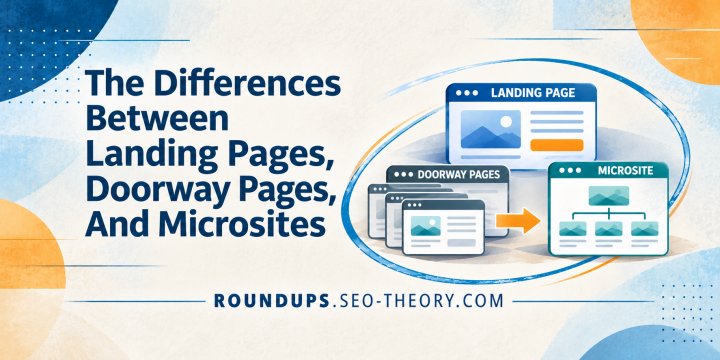
Web marketers use landing pages, doorway pages, and microsites to attract visitors, organize information, and support promotional campaigns. Although these approaches sometimes overlap, they serve different purposes. The distinction depends less on where content is published than on what the content offers visitors and how it fits into a broader website strategy.
Several articles from the SEO Theory archives examine these distinctions, including the legitimate uses of specialized websites and the problems associated with pages created primarily to manipulate search results.
What Makes a Page a Landing Page?
A landing page is, in the broadest sense, any page through which a visitor enters a website. In marketing, however, the term often refers to a page designed for a particular audience, advertisement, or conversion objective.
The article What IS A Landing Page, and Other Marketing Terms explains why the terminology can be confusing. Advertisers, search marketers, and website publishers may use the same phrase differently. An advertising landing page might be designed to encourage a purchase or collect an inquiry, while an organic search landing page may simply provide the information a searcher requested.
These uses are not inherently incompatible. A page can satisfy an informational need while also offering visitors an opportunity to take another action. Its effectiveness depends on how well it serves the audience arriving there.
When Does a Landing Page Become a Doorway Page?
Doorway pages are generally created to attract search traffic and direct visitors toward another destination, often without providing substantial independent value.
The distinction is examined in How to Make Content Rich Doorway Pages That Last, an older SEO Theory article that emphasizes the importance of providing useful information rather than relying on large quantities of automatically generated content.
The article argues that pages targeting different products, services, or informational needs should provide meaningful value for the people searching for those subjects. Merely producing numerous pages with slightly different wording does not accomplish that objective.
This principle remains relevant even though search engine policies and terminology have evolved. A specialized landing page is not necessarily a doorway page simply because it targets a narrow subject or encourages visitors to continue elsewhere. The more important questions concern the page’s independent usefulness, its relationship to similar pages, and whether its primary purpose is to help visitors or capture search visibility.
Microsites Can Serve Independent Purposes
A microsite is a relatively small website organized around a specific subject, product, audience, or campaign. It may operate on its own domain or as part of a larger organization’s publishing network.
The SEO Theorist article Doorway Pages Versus Microsite examines the difference between publishing a specialized website and constructing pages primarily to funnel traffic elsewhere.
A legitimate microsite can provide focused information, develop its own audience, and offer a distinct experience. It does not have to reproduce the structure or subject coverage of a larger corporate website.
Another archive article, The Microsite Mistake – Mistaking Microsites for Mistakes, challenges the assumption that using separate websites is inherently an SEO error. Its central distinction is between microsites that offer independent value and websites created chiefly to manufacture links or artificial authority.
The number of domains an organization operates does not, by itself, establish whether its publishing strategy is useful or manipulative.
The Common Requirement Is Useful Content
These archive discussions approach website organization from different directions, but they share an underlying principle: a page or website should justify its existence through the value it provides visitors.
Landing pages can support advertising and search traffic. Microsites can address specialized audiences or subjects. Both can become problematic when publishers substitute repetitive, low-value content for useful information.
The relevant distinction is therefore not simply between a page and a website, or between a primary domain and a separate domain. It is between publishing resources that serve identifiable visitor needs and creating additional search entry points without a corresponding benefit.
For publishers considering these approaches, the older articles provide a useful framework for evaluating why specialized pages and websites are created, what visitors should expect from them, and whether their content fulfills those expectations.