
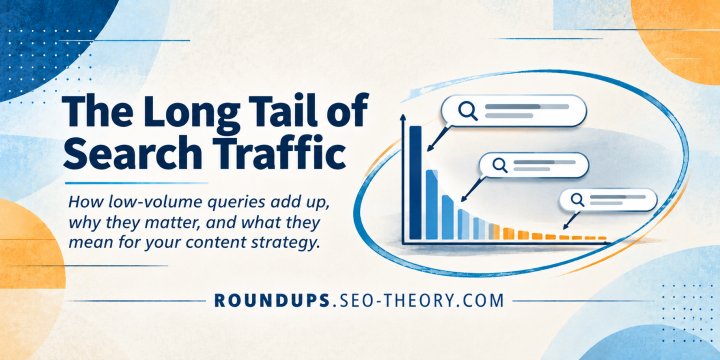
Search traffic is not distributed evenly across search queries. Some queries are performed frequently, while many others occur relatively rarely. Although these less common searches may generate little traffic individually, their combined contribution can be substantial.
The long tail of search has been an important subject in SEO Theory network articles for many years. These discussions explore the limitations of keyword research, the value of specialized content, the development of new query spaces, and the role of low-volume searches in building sustainable website traffic.
Long-Tail Queries Are Not Necessarily Long Phrases
The long tail describes the distribution of search frequency, not the number of words in a query. A short, unusual phrase may receive fewer searches than a longer, more popular expression.
This distinction is important because publishers sometimes confuse long-tail SEO with targeting lengthy keyword phrases. The defining characteristic is relatively low search frequency, not phrase length.
The article Long Tail Content Strategy for People Who Don’t Understand the Long Tail provides a starting point for understanding this distinction and its implications for content planning.
Keyword research tools can also create a misleading impression of search demand. Queries reported as having little or no search volume may still represent genuine searcher interests. Furthermore, an individual article may attract visitors through many different queries, including expressions that were never considered during content planning.
Why Low-Traffic Queries Deserve Attention
The value of long-tail search traffic lies in the combined contribution of many individually uncommon searches.
A website that attracts visitors through hundreds or thousands of low-frequency queries may receive substantial organic search traffic without depending entirely on a few highly competitive keywords.
The article Why You SHOULD Try To Rank For Low Traffic Queries explores the potential value of searches that individually attract relatively few visitors.
However, low search volume does not automatically make a query worth targeting. Publishers must still consider whether they can satisfy the underlying searcher intent and whether the resulting content serves a useful purpose.
A page may also attract traffic through several related queries. This means its total search potential cannot necessarily be estimated from the reported volume of a single keyword.
Expanding Search Opportunities Through Content
In 50 Ways to Get Poker Traffic, published in March 2009, Randy Ray discussed several ways publishers could expand their search visibility.
Among his recommendations were publishing additional content, researching more long-tail queries, addressing related keyword variations within individual pages, and developing detailed coverage of specialized subjects.
The article also proposed creating query spaces around subjects or terminology that had not previously attracted significant search interest.
These recommendations illustrate two different approaches to developing search traffic. Publishers can create content to satisfy existing search demand, or they can introduce useful concepts that may eventually become subjects of additional searches.
The underlying principle remains relevant, although simply publishing more pages or adding keyword variations does not guarantee greater visibility.
Developing New Query Spaces
Search demand is not necessarily fixed. New products, ideas, terminology, and public discussions can create reasons for people to perform searches that were previously uncommon or nonexistent.
The article How To Build A Query Space provides another perspective on the relationship between content development and the emergence of related searches.
A publisher introducing a useful concept may initially receive little search traffic because few people know the terminology. As awareness develops, additional searches may emerge around that subject.
This differs from conventional keyword targeting, which generally begins by identifying queries people already perform.
Creating a query space is not a predictable way to generate traffic. Nevertheless, the concept helps explain why existing keyword data cannot fully describe a website’s future search opportunities.
Building a Long-Term Content Strategy
The relationship between long-tail searches and sustainable content development is addressed in How to Develop SEO Strategies That Last a Long Time.
The article emphasizes developing useful content capable of attracting a wider range of searches over time, rather than depending entirely on rankings for predetermined keywords.
Publishers cannot anticipate every query relevant to their content. Searchers may use unfamiliar terminology, combine concepts in unexpected ways, or begin searching for subjects that previously attracted little attention.
A durable content strategy therefore leaves room for discovery. Publishers can develop substantial coverage of useful subjects, address related questions, and expand their content as additional information needs become apparent.
Organizing and Connecting Long-Tail Content
The article Use Segue Sites to Collate Long-tail Traffic introduces another aspect of the discussion: how publishers organize traffic opportunities across related content or websites.
Content organization matters because a publisher may address numerous specialized interests that overlap without being identical. Relevant internal links and coherent subject coverage can help visitors discover additional information.
However, building separate websites is not inherently necessary to benefit from long-tail traffic. Publishers should organize content according to its purpose and the needs of their audiences rather than assuming that more websites or pages will automatically generate more search referrals.
What the Long Tail Means for Publishers
Long-tail SEO is not simply a matter of identifying obscure keywords and creating individual pages for them.
It involves recognizing that search demand is distributed across many queries, that individual pages may attract visitors through unexpected searches, and that new information needs can emerge after content is published.
Publishers can respond by developing useful subject coverage, addressing meaningful distinctions, and reviewing actual search performance to discover opportunities that keyword research may have overlooked.
Low search volume does not necessarily indicate low content value. The collective contribution of uncommon searches can be significant, while useful content may continue attracting new combinations of queries long after its original publication.